


 dB
rejection of the upper side band in the 80-120 GHz waveguide
band. Selectivity of the mixer tuning is due to a fixed
E-plane tuner integrated in the block. A single backshort is
used for the tuning. Minimum DSB receiver noise with the new SIS mixer
in laboratory test is about 26 K. In 1994 new 3 mm mixers were
prepared and installed at Pico Veleta and on antenna 4 at Plateau de
Bure. Minimum SSB receiver noise measured on antenna 4 is about 44 K.
dB
rejection of the upper side band in the 80-120 GHz waveguide
band. Selectivity of the mixer tuning is due to a fixed
E-plane tuner integrated in the block. A single backshort is
used for the tuning. Minimum DSB receiver noise with the new SIS mixer
in laboratory test is about 26 K. In 1994 new 3 mm mixers were
prepared and installed at Pico Veleta and on antenna 4 at Plateau de
Bure. Minimum SSB receiver noise measured on antenna 4 is about 44 K.
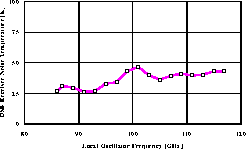
Figure 1: Operation of the new 3 mm SIS mixer prepared for antenna 3
at Plateau de Bure in a laboratory receiver with cooled
optics. Minimum DSB receiver noise temperature is about 27 K. With a
forward efficiency of 93% at the 15 m telescopes, in good weather
condition such receiver still contributes more than 50% of the system noise
temperature. Further improvement of the mixer is in progress.
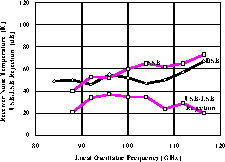
Figure 2: Receiver performance with a new 3 mm mixer with an E plane
stub. This is a spare Plateau de Bure receiver with ambient temperature
optics and a diplexer for LO injection. Later this mixer was installed
in the 30 m telescope receiver.
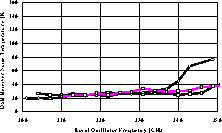
Figure 3: Operation of the receiver with the new 1.3 mm SIS mixers
prepared for the dual channels receivers of Plateau de Bure
antennas 1-3. Receiver structure is similar to the real receiver:
optics is cooled and the local oscillator is injected by a coupler. This
is the first design of SIS junctions with the fully optimized
integrated circuit.
 m
m SIS junction was prepared and tested during 1994. With a 4 GHz IF
this mixer tuning gives 18 dB image rejection over all the 1.3 mm
receiver band in a good accord with the model prediction. A mixer
with this performance was prepared for Pico Veleta G2 receiver early
in 1994. The Plateau de Bure receiver 1.5 GHz IF is relatively lower
and the image band rejection is not so efficient. Four mixers were
prepared for the new generation of the Plateau de Bure
receivers. Receiver DSB noise temperature with the new mixers may be
as low as 20 K, never achieved at this wavelength before.
SIS junction was prepared and tested during 1994. With a 4 GHz IF
this mixer tuning gives 18 dB image rejection over all the 1.3 mm
receiver band in a good accord with the model prediction. A mixer
with this performance was prepared for Pico Veleta G2 receiver early
in 1994. The Plateau de Bure receiver 1.5 GHz IF is relatively lower
and the image band rejection is not so efficient. Four mixers were
prepared for the new generation of the Plateau de Bure
receivers. Receiver DSB noise temperature with the new mixers may be
as low as 20 K, never achieved at this wavelength before.