


 , S. Guilloteau
 , P. André
 ,
C. Bertout
,
C. Bertout , T. Montmerle
 , K. Schuster
 Observatoire de Grenoble, BP 53, F-38041 Grenoble Cedex 9, France
 DEMIRM, Observatoire de Paris, 61 Avenue de l'Observatoire, F-75014
Paris, France
DEMIRM, Observatoire de Paris, 61 Avenue de l'Observatoire, F-75014
Paris, France Institut de Radioastronomie Millimetrique, 300 rue de la Piscine,
38406 Saint-Martin d'Hères, France
Institut de Radioastronomie Millimetrique, 300 rue de la Piscine,
38406 Saint-Martin d'Hères, France Service d'Astrophysique, Centre d'Etudes de Saclay, F-91191
Gif-sur-Yvette, France
Service d'Astrophysique, Centre d'Etudes de Saclay, F-91191
Gif-sur-Yvette, France  CO (J=1-0) observations of HL Tau with the IRAM Plateau de
Bure interferometer (PdBI, 3
CO (J=1-0) observations of HL Tau with the IRAM Plateau de
Bure interferometer (PdBI, 3 beam) and the IRAM 30-m (22
 beam). On
a large scale, HL Tau drives an anisotropic, mostly redshifted bipolar
outflow, and is located within a flattened remnant envelope roughly
perpendicular to the jet axis, of mass
beam). On
a large scale, HL Tau drives an anisotropic, mostly redshifted bipolar
outflow, and is located within a flattened remnant envelope roughly
perpendicular to the jet axis, of mass  0.2 M
0.2 M . PdBI
maps reveal small-scale structures nested within these regions. A broad
range of velocities is present. However, interferometric maps are severely
contaminated by extended emission for velocities less than 0.8 km s
. PdBI
maps reveal small-scale structures nested within these regions. A broad
range of velocities is present. However, interferometric maps are severely
contaminated by extended emission for velocities less than 0.8 km s from
line center, which hampers a totally unambiguous interpretation. In the
present analysis we concentrate on velocities sufficiently large to be
mostly unaffected by this confusion problem.
from
line center, which hampers a totally unambiguous interpretation. In the
present analysis we concentrate on velocities sufficiently large to be
mostly unaffected by this confusion problem.
We do not find convincing evidence for rotation in our data. We also
identify several problems with the pure infall interpretation proposed by
Hayashi et al. (1993). The required central mass would be at least

 for
for  , which seems uncomfortably
large. In addition, the detailed velocity structure and the asymmetry
between blueshifted and redshifted gas are not well explained. Hence,
infall alone cannot reproduce all of our observations. We derive an upper
limit to the free-fall rate toward HL Tau of
, which seems uncomfortably
large. In addition, the detailed velocity structure and the asymmetry
between blueshifted and redshifted gas are not well explained. Hence,
infall alone cannot reproduce all of our observations. We derive an upper
limit to the free-fall rate toward HL Tau of 
 yr
yr .
.
The problems encountered by an infall model, together with the known presence of a molecular outflow from HL Tau, lead us to propose that kinematics in the remnant envelope around HL Tau are heavily affected by entrained outflow motions. The distinctive blue/red asymmetric structure in our PdBI maps (blueshifted emission is weaker and mostly confined in the system midplane, while redshifted emission is stronger and more closely follows the jet axis) is then naturally accounted for, as the same asymmetry is observed in the large-scale bipolar outflow from HL Tau.
The action of jet bow shocks, or the steady-state entrainment of
circumstellar gas, seems able to explain the transverse extent of the
perturbed gas and its overall kinematics. The net molecular mass
outflow rate is large (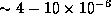 M
M yr
yr  ), far
exceeding the present disk accretion rate, and at least comparable to the
envelope infall rate. Envelope clearing by jet entrainment could then be
an important process regulating the inner disk accretion rate in HL Tau, as
well as the transition to the fully optically revealed T Tauri stage.
), far
exceeding the present disk accretion rate, and at least comparable to the
envelope infall rate. Envelope clearing by jet entrainment could then be
an important process regulating the inner disk accretion rate in HL Tau, as
well as the transition to the fully optically revealed T Tauri stage.
If our estimates of outflow and infall rates are correct, the modest remnant
mass 
 inferred from our IRAM 30-m observations
indicates that HL Tau has already accumulated most of its final stellar
mass, and that it is in a relatively short-lived (
inferred from our IRAM 30-m observations
indicates that HL Tau has already accumulated most of its final stellar
mass, and that it is in a relatively short-lived ( yr) phase of energetic mass ejection, leading to envelope dispersal.