


 , A. Fuente
 and M. Tafalla
 Centro Astronómico de Yebes (OAN, IGN), Apartado 148, E-19080
Guadalajara, Spain
Centro Astronómico de Yebes (OAN, IGN), Apartado 148, E-19080
Guadalajara, Spain Harvard-Smithsonian Center for Astrophysics, MS 42, 60 Garden Street,
Cambridge, MA 02138, USA
Harvard-Smithsonian Center for Astrophysics, MS 42, 60 Garden Street,
Cambridge, MA 02138, USA  1 and
CS 3
1 and
CS 3 2 lines of the molecular gas around the embedded
object IRAS 20050+2027 (figure reffig:bachiller). This is a 260
2 lines of the molecular gas around the embedded
object IRAS 20050+2027 (figure reffig:bachiller). This is a 260
 source located in the Cygnus Rift at 700 pc from the
Sun. The CS data uncover a dense core of size 0.3 pc, and 80
source located in the Cygnus Rift at 700 pc from the
Sun. The CS data uncover a dense core of size 0.3 pc, and 80
 centered on the IRAS object. The CO map reveals a
remarkable molecular outflow consisting of three pairs of lobes
emanating from the close vicinity of the IRAS source. One of the lobe
pairs is a highly-collimated jet of extremely high-velocity emission
(LSR velocities up to
centered on the IRAS object. The CO map reveals a
remarkable molecular outflow consisting of three pairs of lobes
emanating from the close vicinity of the IRAS source. One of the lobe
pairs is a highly-collimated jet of extremely high-velocity emission
(LSR velocities up to  70 km/s) containing molecular ``bullets''.
We briefly examine different possibilities to explain the complex structure of the multipolar outflow. A single outflow appears unable to explain all the CO observations, so we suggest that two or three independent outflows emanate from different young sources embedded within the core.
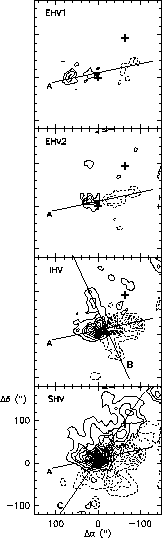
Figure 5: CO 2--1 channel maps of the IRAS 20050 outflow.
The channels, denoted by EHV1, EHV2, IHV, and SHV, are 50, 25, 10, and
5 km/s wide, and are centered at  =
70, 32.5, 15, and 7.5 km/s, respectively, where
=
70, 32.5, 15, and 7.5 km/s, respectively, where  = 6 km/s is the
velocity of the ambient cloud. First contour and step are at 10 K
km/s for the EHV intervals, and 7 K km/s for the SHV and IHV
intervals. Solid contours are for the blue-shifted emission, and
dashed contours for the red-shifted. The origin is at the nominal
position of IRAS 20050. The crosses represent the IRAS sources
IRAS 20050 and IRAS 20049+2721, and the triangle marks the position of a
strong CS emission peak. The axes A, B, C are drawn to illustrate the
multi-lobe structure of the outflow.
= 6 km/s is the
velocity of the ambient cloud. First contour and step are at 10 K
km/s for the EHV intervals, and 7 K km/s for the SHV and IHV
intervals. Solid contours are for the blue-shifted emission, and
dashed contours for the red-shifted. The origin is at the nominal
position of IRAS 20050. The crosses represent the IRAS sources
IRAS 20050 and IRAS 20049+2721, and the triangle marks the position of a
strong CS emission peak. The axes A, B, C are drawn to illustrate the
multi-lobe structure of the outflow.