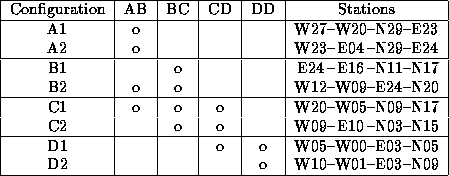
We have revised the list of configurations to take into account the advent of the 1.3 mm receivers and of the new stations. The standard set includes four basic arrays built upon a primary set of eight 4-antenna configurations (Table 1):
Table: Available configurations
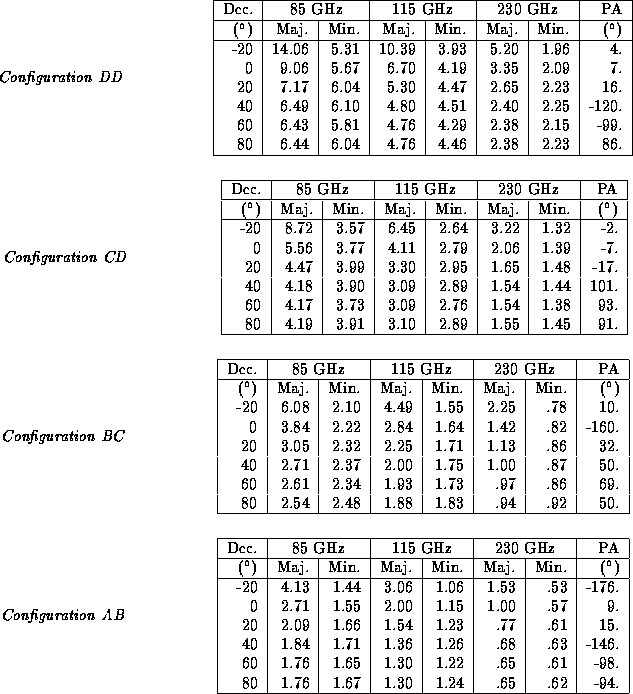
The arrays, named AB, BC, CD and DD are reasonably suited for all declinations (see Table 2).
 at 115 GHz (
 at 230 GHz),
but offers little sensitivity to extended structures.
at 230 GHz),
but offers little sensitivity to extended structures.
 at 230 GHz, however.
 at 100 GHz and the shortest possible
spacing is 24 m, to avoid collisions between two antennas. Even taking
into account projection effects that shorten the effective baseline,
sources larger than about
at 100 GHz and the shortest possible
spacing is 24 m, to avoid collisions between two antennas. Even taking
into account projection effects that shorten the effective baseline,
sources larger than about  are heavily resolved at 110 GHz.
Non imaging projects, such as detection experiments, size measurements, snapshots, etc., should use a subset of the standard configurations. This subset can either be specified by the observer, or left undefined until final scheduling if any configuration is appropriate (a detection experiment for example).
Table: Beam sizes (in arc seconds)
Stéphane GUILLOTEAU